

Food & Beverage

Photos courtesy of Springhouse Farm
Springhouse Farm: Cultivating Resilience and Community in the High Country
By Julie Farthing
When the mountain air starts to lose its bite and the early summer sun begins to warm the earth, Springhouse Farm kicks into high gear.
Established in 2008 by Jean and Amy Fiedler, a mother and daughter team who initially sold their harvest with only a modest table and an umbrella, Springhouse Farm is now a destination.
“Mom and I started planting 18 years ago. Farming has always been in me but I am totally self-taught,” says Amy of her first years on the farm. “I went to a lot of conferences and had a local mentor, Charles Church, who was a respected farmer in the High Country. We started with a small garden and mom and I grew tomatoes and lettuce that first year. We had a lot of rain that summer so it was a bad year for tomatoes but a good year for lettuce,” Amy laughs. “As the years progressed, we went from planting on a quarter acre to eight acres.”
To a visitor stopping by in June or July, the fields look like a living quilt of vibrant greens and floral pops of color. Every variety of flowers that grace the fields started out as seeds, meticulously tucked into propagation trays that line the greenhouse tables. Long before the first robin appears, these seedlings are moved to grow tunnels to get used to the mountain air while staying safe from any late-season chills. Once the threat of frost is truly gone, it becomes a total summer sprint with all hands on deck. Using every square inch of the 8-acre plot, as one crop is pulled and put into a basket, the next one is going into the ground. It’s a constant dance to make sure the community never sees an empty shelf. “We do intensive farming,” Amy says of the continuous crop rotation. “The minute something comes out, we put something back in.”
Springhouse also serves as a classroom for Appalachian State University’s Sustainable Development students. Amy leads a team of mostly female interns, teaching them regenerative farming and the importance of nutrient-dense “medicine-food.” The interns gain practical, hands-on experience in the rigors of sustainable agriculture.
“These students have been sitting in a classroom, but have never really implemented those skills. So they come here and get their hands in the dirt and learn from the practical side of farming,” she explains. “The transfer of knowledge is the biggest trade-off, and they gain an incredible work ethic.”
One of her new interns recently scanned the bucolic scene before her and remarked how dreamy everything was. “I work nine days a week, ten hours a day, and my back hurts because I’m not twenty anymore—and looking over the fields all I see is work,” Amy says of the pastoral view. “I only see all the plants we’ve put in and all the ones we’ve lost already. So, I have to shape shift the feeling of exhaustion and change it into gratitude and appreciation.”
Much of that gratitude began soon after Helene hit and destroyed years of hard work. “She came from that little creek, and that creek down there,” Amy points out, referring to the flood waters of Helene. “It just took everything.”
Not only did the storm wash away the Farm Stand, hundreds of perennial plants, and precious topsoil, it also deposited hundreds of rocks and trash from upstream. “We went to cultivate the lower field but the soil was too rocky,” says Amy of the hurricane aftermath. “I thought, ‘I’ve always wanted a pond,’ so a guy working here at the time dug down four feet until he hit a spring, and now it’s a naturally fed pond,” she gazes at the pool of water just beyond the Farm Stand. “So, now I have expanded to aquaculture and have toads and I’m going to get fish and plant native grasses. You never stop learning. Helene turned something really bad into something positive.”
The new and improved Farm Stand is the vibrant intersection where Springhouse Farm’s bounty meets the community’s trust. This stand is more than just a marketplace; it is a symbol of resilience, having been rebuilt by Appalachian State University’s Building Sciences Department students after Hurricane Helene destroyed the original structure. It operates entirely on the deeply-held honor system, offering the freshest vegetables, beautiful flower bouquets, plant starts, and farm-inspired merchandise—all made available through mutual respect and community faith. Availability is always subject to the rhythms of the season.
Beyond the daily rhythms of planting and harvesting, Springhouse Farm serves as a lively hub for connection and celebration. The farm gates swing wide for a series of seasonal events designed to root the community deeper into the land and each other.
The “You-Pick” flower events offer a hands-on experience in the fields, allowing guests to wander through the blooms and curate their own bouquets. These gatherings are often centered around various activities that encourage visitors of all ages to linger and enjoy the mountain air.
For those seeking a taste of the harvest, special farm dinners bring the bounty directly to the table. From romantic date nights under the wide Appalachian sky to sun-drenched community brunches, these meals highlight the freshest ingredients, often traveling only a few yards from soil to plate.
The farm also continues its mission as an outdoor classroom, hosting guest speakers and workshops focused on regenerative practices and sustainable agriculture. These educational opportunities allow neighbors to learn directly from experts and practitioners, fostering a shared commitment to keeping the High Country food system healthy and resilient for generations to come.
Amy’s mom, Jean, summed up the mother-daughter’s mission for Springhouse Farm:
“Amy and I have this very strong stewardship of taking care of this land. It’s not ours, it’s just passing through our hands at this point in time.”
To stay up to date on all farm activities, including You-Pick events, farm dinners, and workshops, please visit the Springhouse Farm website at springhousefarm.net. The Farm is located at 433 Silverstone Rd, Vilas, NC, just 15 minutes from downtown Boone and Appalachian State University.
Return to Featured Content on the Home Page >>
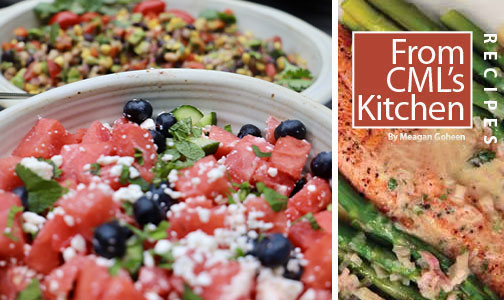
From the CML Kitchen…
By Meagan Goheen
Black Cherry Farro Salad
INGREDIENTS
1 cup farro
2 cups vegetable broth
½ tsp salt
1 cup of black cherries, pitted and sliced in half
1 cap garbanzo peas, drained and rinsed
1 cup chopped kale
2 garlic scapes, diced (you can find at one of our local farmers’ markets, or replace with 2 garlic cloves, minced)
¼ cup flat leaf parsley, diced
½ cup crumbled feta
¼ cup pistachios
DRESSING
2 TBSP balsamic vinegar
2 TBSP extra virgin olive oil
1 TBSP honey
1 tsp soy sauce
1 tsp salt
½ tsp freshly ground black pepper
DIRECTIONS
– Mix dressing ingredients and set aside.
– Cook farro according to instructions, replacing water with vegetable broth.
– To a large bowl add black cherries, garbanzo peas, garlic, parsley, farro and dressing; mix to combine.
-Top with feta and pistachios.
*Delicious at room temperature or chilled for a potluck, picnic or meal prep .
Serve and enjoy!